Photographer: Benjamin Healley, Museums Victoria, CC BY 4.0, via Openverse
There is a stone on the island of Yap that sits at the bottom of the sea, and for a long time it was counted as part of one family's fortune. Nobody alive had seen it. Everyone agreed it was there, and that was enough.
That story, recorded by an American anthropologist more than a century ago, is the best-known detail about rai, the carved stone discs that Yapese people used as money. It sounds like a curiosity, and it is. It also happens to be one of the clearest illustrations of what money actually is, which is why economists keep coming back to it.
Yap is a small group of islands in the western Pacific, today part of the Federated States of Micronesia. Day to day, people there pay for things in US dollars. But the old stones are still around, propped against houses, lining paths and gathered in village "banks" in the open air.
Quarried on another island
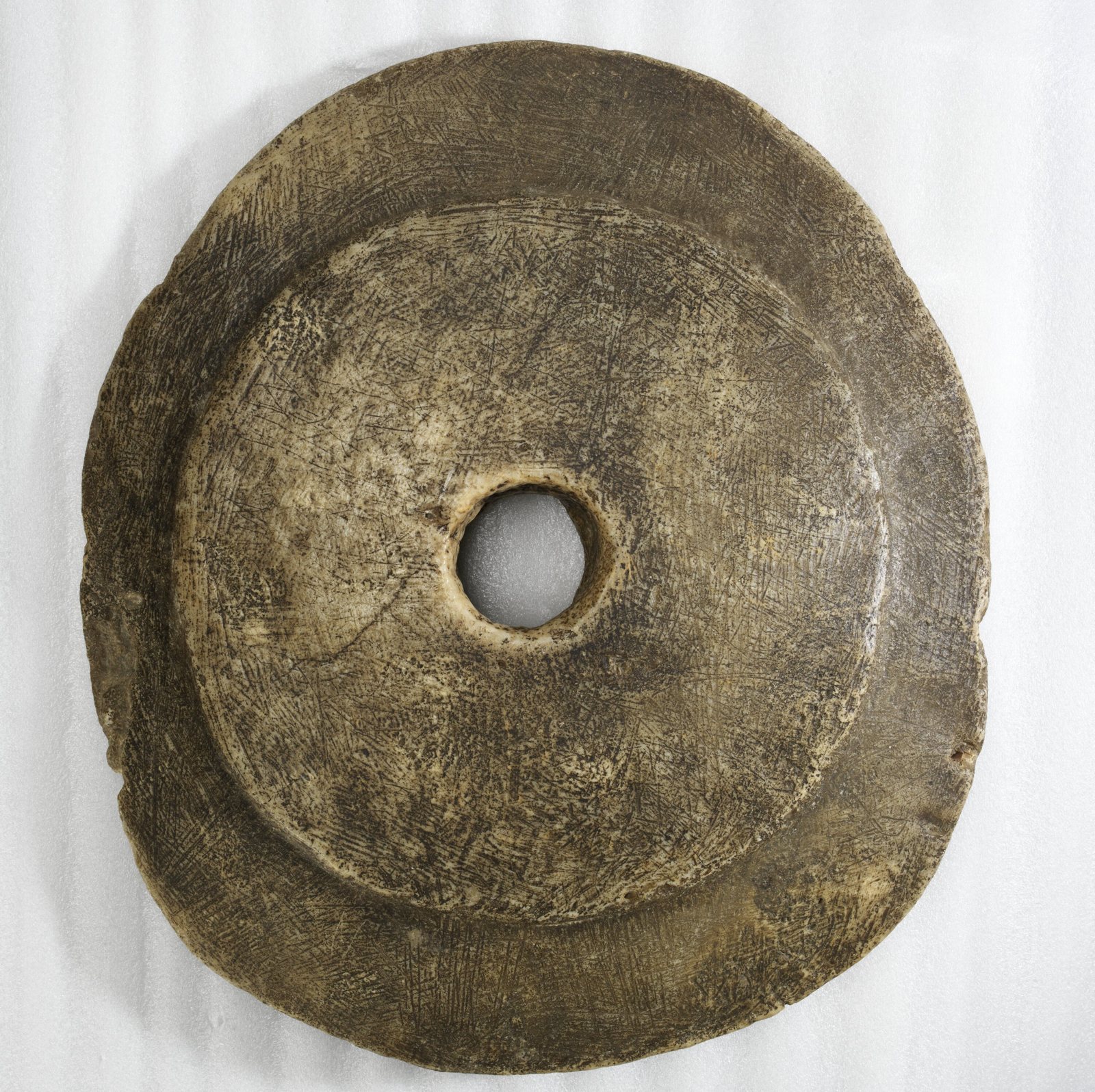
The odd thing about rai is that the stone does not come from Yap. It is limestone, and the Yapese quarried it on Palau, roughly 250 miles away across open ocean. They carved it into discs with a hole through the middle, so a pole could be slipped through for carrying, then brought the discs home by canoe and raft.
Sizes vary enormously. Some rai are small enough to hold in two hands, like the one in the photo above, now in the collection of Museums Victoria in Australia. The biggest are around 12 feet across and weigh several tonnes. You don't put one of those in your pocket.
That journey is the key to their value. A stone was worth more if it was large and well made, but also according to its history: who had brought it, how hard the trip had been, and whether people had died getting it back. Two stones of the same size could be worth very different amounts.
How a payment worked without moving anything
Because the big stones were so heavy, they usually stayed where they were. When one changed hands, as part of a marriage, a land deal or a settlement between families, the community simply agreed that it now belonged to someone else. The stone might stay outside the old owner's house for years.
So what really mattered was the shared memory of who owned what. Think of it as a ledger, kept in people's heads and confirmed in public. Hence the sunken stone. According to the account by William Henry Furness III, who visited Yap and wrote The Island of Stone Money (1910), a stone had been lost overboard during a storm on the way home from Palau. The crew vouched that it had been a fine stone and that its loss wasn't the owners' fault, and so the family went on being treated as its owners even though it was underwater.
(I find that more reasonable than it first sounds. Most of my own savings are numbers on a server I have never seen.)
The sea captain who flooded the market
In the late 19th century an Irish-American captain named David O'Keefe arrived and spotted a business opportunity. With a ship and iron tools, he could quarry and carry rai far faster than anyone using canoes. He traded the stones to Yapese islanders for copra (dried coconut, valuable for its oil) and sea cucumbers, and did very well out of it.
It is an early example of what happens when someone can suddenly produce a lot more of a form of money. The Yapese response was sensible: stones brought by O'Keefe were generally valued less than older ones, because they had cost so much less effort. Easy money, quite literally, was worth less. His story later became a Hollywood film, His Majesty O'Keefe (1954), starring Burt Lancaster, which is about as reliable a history lesson as you would expect.
Milton Friedman and the gold that stayed in the vault
In 1991 the economist Milton Friedman wrote a short paper about Yap, borrowing Furness's title. His point was that the islanders were not doing anything stranger than central banks.
He compared the sunken stone with an episode from the early 1930s, when the Bank of France asked the Federal Reserve Bank of New York to set aside part of its dollar holdings in gold. The gold never crossed the Atlantic. Staff in New York simply moved it to separate drawers and labelled it as belonging to France. Markets treated that as a loss of gold for the United States and a gain for France, even though not an ounce had moved.
Friedman's argument was that both systems rest on agreement. A rai stone at the bottom of the sea and a bar of gold in a labelled drawer are both money because people accept the record of who owns them. Since bitcoin arrived, plenty of writers have also pointed at Yap as an early "distributed ledger", which is a bit of a stretch, though not a silly one.
Stone money today
Rai have not disappeared. They are still used in traditional exchanges on Yap, where custom matters more than market value. You will also find examples in museums around the world, including the Bank of Canada Museum in Ottawa, which has one on display.
What I take from Yap is a useful way of looking at your own money. Your bank balance is an entry in a ledger, and its value depends on trust in the bank, in the deposit insurance behind it and in the currency itself. That is worth remembering the next time a payment app or a new kind of "coin" asks you to trust its record. The questions the Yapese answered in public (who keeps the record, who checks it and what happens when something goes wrong) are still the right ones to ask. This is general information, not financial advice, but it is a habit worth having.
Enjoyed this story?Get a new one every day on social.