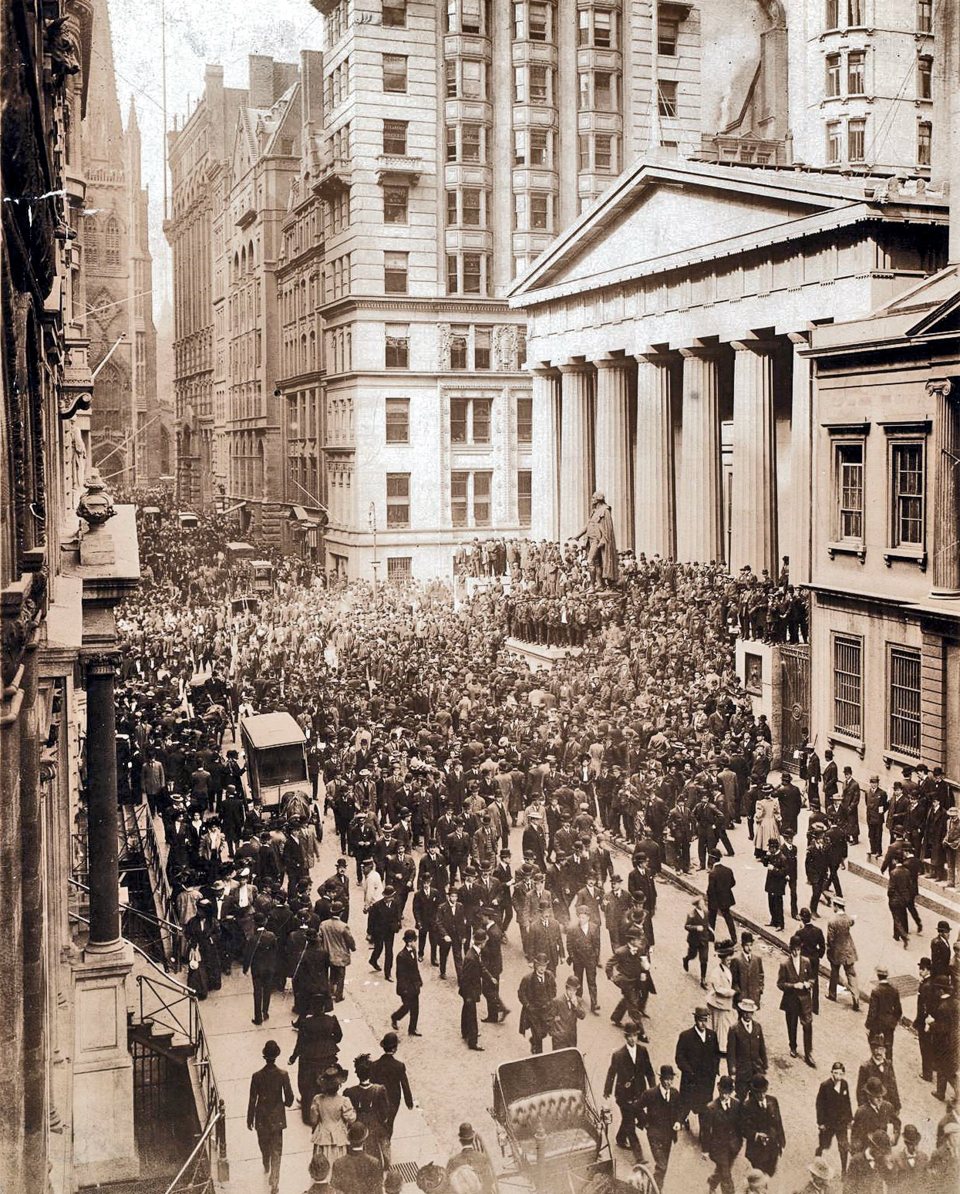
Photo: unknown author, public domain, via Wikimedia Commons
At around 3 a.m. on Sunday, November 3, 1907, roughly 120 of New York's bankers were inside J.P. Morgan's private library on East 36th Street, and by the most famous account of that night, the door was locked and the key was in somebody's pocket. Morgan was 70 years old and held no public office. He wanted the city's trust companies to put up $25 million to save their weakest members, and he had no intention of letting anyone go home until they did.
It took until about 4:45 a.m. They signed.
The story gets told as a piece of Gilded Age theater, and it was. It's also a big part of the reason the United States has a central bank, which makes it one of the more consequential sleepless nights in American money. It started today, 119 years ago.
A failed bet on copper
The trouble began with a stock play. In mid-October, Otto Heinze tried to corner the shares of United Copper. The stock went from $39 to $52 in a day, then collapsed. By October 16 it was at $10 and his brokerage had failed.
That should have been a small story. But the Heinze name, and that of the speculator Charles W. Morse, was tied to a chain of banks, and depositors began asking who else was exposed. On October 21 Charles T. Barney resigned from the Knickerbocker Trust Company over his links to the two men. The next day depositors lined up outside its doors. About $8 million went out in under three hours, and shortly after noon the Knickerbocker stopped paying.
Why trust companies were the weak spot
Trust companies were the fast-growing, loosely regulated part of the banking world in 1907. They took deposits like banks but kept much thinner cash reserves than national banks did, and they weren't in the network that let banks settle with each other easily. That was fine in good times, when thin reserves meant better returns.
In a run it was a disaster, because no institution existed whose job was to lend to a sound bank during a scare. There was no Federal Reserve, and there was no deposit insurance. If you were a saver and the line outside your bank was getting longer, the only sensible move was to join it. Bankers call that a bank run. Everyone else calls it being afraid, and I'd have been out there too.
One old man and a very long two weeks
Into that gap stepped Morgan. He organized the rescue from a run of meetings, deciding which institutions were sound enough to save. When the Trust Company of America came under attack, he declared it the place to stop the trouble, and the other trust presidents lent it $8.25 million.
The Treasury put about $25 million into New York banks, and John D. Rockefeller deposited $10 million with National City Bank. On October 24 the president of the New York Stock Exchange came to Morgan because brokers couldn't borrow and the exchange might have to close early. Within about 45 minutes, 14 bank presidents had pledged $23.6 million. Days later, New York City itself was on the brink, and Morgan arranged for the purchase of $30 million in city bonds.
It's an odd thing to read now. A private citizen was doing what a government agency does today, and the Treasury Secretary was more or less working alongside him.
The night at the library
By early November a brokerage called Moore & Schley was close to failing. Its loans were backed by shares of Tennessee Coal, Iron & Railroad, a stock few people traded and whose price was sliding. If the firm went down, it could take a lot of Wall Street with it.
The plan that took shape over the weekend of November 2 had two parts. Morgan would support the brokerage only if the trust companies rescued their own weakest members, Lincoln Trust among them. Hence the bankers in the library in the small hours, and hence the $25 million.
The second part was a deal for U.S. Steel to buy Tennessee Coal, which needed approval from a president who liked to go after monopolies. On Sunday night Henry Clay Frick and Elbert Gary took an overnight train to Washington. Theodore Roosevelt agreed on Monday morning before the market opened, and confidence came back. He would be criticized over that decision for years.
The locked door, I should say, rests on later recollections, and historians tell it with varying degrees of relish. The meeting, the hour and the money are not in doubt.
What the panic left behind
The rescue worked, but the country paid anyway. Between May 1907 and June 1908, production fell 11 percent, and unemployment rose from under 3 percent to 8 percent. And plenty of people were uneasy that the system's survival had depended on one elderly financier. Morgan himself would be dead by 1913.
Congress passed the Aldrich-Vreeland Act in May 1908, which created a commission to study banking reform. In November 1910 Senator Nelson Aldrich and a small group of financiers met secretly at Jekyll Island in Georgia to sketch out a plan. Three years later, on December 23, 1913, Woodrow Wilson signed the Federal Reserve Act.
What this means for your own savings
The trust-company depositors of 1907 had no safety net. You most likely do. FDIC insurance came along in 1933, and the standard limit is $250,000 per depositor, per insured bank, for each ownership category. Credit unions have similar federal coverage through the NCUA. Congress has debated changing those limits, so check the current figures on the agencies' own websites before relying on them.
Two practical points follow. If you keep more than the limit in one bank, it's worth learning how ownership categories work. And be careful with products that look like bank accounts but aren't: some apps and investment accounts aren't insured the way a deposit is, or only through a partner bank.
This is general education, not advice about your own money.
Enjoyed this story?Get a new one every day on social.